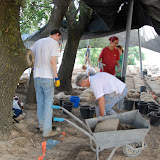
Israel is rescuing refugees from Sudan, housing and feeding them, and offering some of them jobs. These refugees have literally "walked" from Sudan across the wilderness of Egypt (top photo: Ron Cantrell), running across the border into Israel. The plight of the Sudanese refugees is straight out of the dust of history into our present times, and the State of Israel is to be commended for stepping up to the challenge they are facing.
Each refugee family have a horrific story to tell. Many of their personal tragedies have been featured on recent Israeli news broadcasts tearing at the compassionate hearts of Israeli's who are anxious to do their part to ease their suffering. A number of Israeli-based NGOs are hard at work to help the refugees.

(right) A beautiful Sudanese child separated in Egypt from her parents, rescued by the efforts of Israeli's, and reunited in Israel.

(left) Egyptian security guard on the Egyptian-Israeli border

(left) Egyptian security guard on the Egyptian-Israeli border
It is difficult to understand all the dynamics of the Sudan situation, but learning the foundational roots of the conflict will help us to understand the present crisis. Movie moguls and authors have been educating us for years about the history of Sudan. It is simply hard to apply the education until something arrests the attention and the plight is brought into focus. Genocide in Sudan has done that. Although the problem in Sudan is not religious but ethnic it does have a religious element as well. Sorting things out is not easy.
Darfur is only half the Sudanese crisis.
Darfur is only half the Sudanese crisis.
A Look Back
Alan Moorehead, an Australian author living in Britain in the early 1900s, wrote two books on the subject: The White Nile and The Blue Nile (see "Ron Cantrell Bookstore" right column). Sudan is covered in The White Nile story. The sources of the Nile River lie deep in North Africa. The Blue Nile originates at Lake Tana in Ethiopia while the White Nile originates in the Sudan.
Moorehead’s book The White Nile is a lively history of the Victorian search for the source of the river including the extraordinary tales of Richard Burton, John Speke, General Charles Gordon, as well as the famous meeting of Livingstone and Stanley, a classic, originally published in 1960. Vivid descriptions of Zanzibar, the last days of Khartoum and the building of the Suez Canal are the book's theme. The death of Sir Charles Gordon in Khartoum is described. Zanzibar, the island off the east coast of Africa, was the slave market of Muslims raping north African tribes for strong men and women to be sold for gold. Khartoum was the city of destiny for the slave trade. The market for slaves was not only Zanzibar, but a river ran west from Sudan to the coast where the New World could be stocked with kidnapped and enslaved Africans. Thus, the provision for America’s slavery tragedy.
Roots of Islamists in Africa
Alan Moorehead, an Australian author living in Britain in the early 1900s, wrote two books on the subject: The White Nile and The Blue Nile (see "Ron Cantrell Bookstore" right column). Sudan is covered in The White Nile story. The sources of the Nile River lie deep in North Africa. The Blue Nile originates at Lake Tana in Ethiopia while the White Nile originates in the Sudan.
Moorehead’s book The White Nile is a lively history of the Victorian search for the source of the river including the extraordinary tales of Richard Burton, John Speke, General Charles Gordon, as well as the famous meeting of Livingstone and Stanley, a classic, originally published in 1960. Vivid descriptions of Zanzibar, the last days of Khartoum and the building of the Suez Canal are the book's theme. The death of Sir Charles Gordon in Khartoum is described. Zanzibar, the island off the east coast of Africa, was the slave market of Muslims raping north African tribes for strong men and women to be sold for gold. Khartoum was the city of destiny for the slave trade. The market for slaves was not only Zanzibar, but a river ran west from Sudan to the coast where the New World could be stocked with kidnapped and enslaved Africans. Thus, the provision for America’s slavery tragedy.
Roots of Islamists in Africa
These are the root issues of what Sudan is today. The problems stem back centuries. They are ethnic in nature as Muslim Arabs have sought with violent determination to turn Sudan into an Arab Islamic nation. That makes both African Muslims (Darfur) and African Christians (south Sudan) fodder for the Arab Islamic killing machine. Therein lies the religious element.
Picking up on Alan Moorehead’s story, the English movie called the Four Feathers weaves a romantic period story set in the late 1800s. It is a platform upon which the viewer can become well acquainted with the historical issues. Mooreheads story in The White Nile provided the plot for the Four Feathers. The Islamic expectation of a messianic figure that would arrive on the scene at the end of time lies behind the movie. However, if you don’t know that Islam is expecting such a personage, the message escapes you. This Islamic-expected messiah is known as the Mahdi. A clue to the ethnic facet of Sudan lies in the character of Abu Fatma played by Djimon Hounsou in the Paramount film. Playing a black African Muslim, his plight was as tenuous as the British because he was African and not Arab.
Arab.
Djimon Hounsou plays Abu Fatma who tries to help a renegade British soldier who has set out to warn his comrades of the Mahdi's intentions and war methods.
Picking up on Alan Moorehead’s story, the English movie called the Four Feathers weaves a romantic period story set in the late 1800s. It is a platform upon which the viewer can become well acquainted with the historical issues. Mooreheads story in The White Nile provided the plot for the Four Feathers. The Islamic expectation of a messianic figure that would arrive on the scene at the end of time lies behind the movie. However, if you don’t know that Islam is expecting such a personage, the message escapes you. This Islamic-expected messiah is known as the Mahdi. A clue to the ethnic facet of Sudan lies in the character of Abu Fatma played by Djimon Hounsou in the Paramount film. Playing a black African Muslim, his plight was as tenuous as the British because he was African and not
 Arab.
Arab.Djimon Hounsou plays Abu Fatma who tries to help a renegade British soldier who has set out to warn his comrades of the Mahdi's intentions and war methods.
Chaos, Violence Heralds a Messiah
The heralding of this Islamic Mahdi is a growing concern since Iran’s President Ahmadinejad continues to make reference to his soon coming, declaring that the Mahdi's mission is to aright the world and make Islam the last standing religion. Evidently in the 1800s, an Arab named Abdul Muhammad declared himself to be the Mahdi and set in motion a diabolical plan of violence and chaos, recognized by Islamic theology as the signs following the messianic arrival. He slaughtered infidels, including Britain’s General Charles Gordon and all his men in Khartoum.
The heralding of this Islamic Mahdi is a growing concern since Iran’s President Ahmadinejad continues to make reference to his soon coming, declaring that the Mahdi's mission is to aright the world and make Islam the last standing religion. Evidently in the 1800s, an Arab named Abdul Muhammad declared himself to be the Mahdi and set in motion a diabolical plan of violence and chaos, recognized by Islamic theology as the signs following the messianic arrival. He slaughtered infidels, including Britain’s General Charles Gordon and all his men in Khartoum.
Today, Sudan’s capital city is still the launching pad for Arab Islamic genocide, both in Darfur and in south Sudan. Millions of innocent hav e been slaughtered to the point of survivors walking across burning deserts from southern Sudan to find freedom. Over 2,000 Sudanese refugees have made their way through Egypt and escaped across the Israeli borders.
 e been slaughtered to the point of survivors walking across burning deserts from southern Sudan to find freedom. Over 2,000 Sudanese refugees have made their way through Egypt and escaped across the Israeli borders.
 A Refuge in Israel
Each day, more refugees from Darfur and southern Sudan run for the safety of Israel, dodging Egyptian bullets, confident that the Jewish State will treat them humanely. They are calling Israel their "last hope of refuge." In recent months, numbers of them have been housed and hired by an Eilat hotel chain. IDF soldiers and Israeli university students are the ones initially caring for the needs of the refugees as they come across the border and are relocated to communities in the Negev. Doctors from local hospitals are donating their services to treat the refugees for shock and other medical needs. Hotels, kibbutzim, and youth hostels are giving the families a place to rest as Israel considers a short term solution. They are anxious to find a safe resting place. We received a request from the Sudanese Christian refugees for Bibles through our adult children who live and work alongside them in Eilat. I recently made trips from Jerusalem there and brought Bibles to them. It broke my heart to hear one recipient tell us that the Bible was the best gift he had ever had . . . "much better than money." How much we take for granted.
Saving Darfur & the West
At present, we are working with Israeli's who want to bring comfort and relief to these who have suffered at the hands of Islamists in Sudan.
May our governments be bold with a unified strength to put an immediate end to the Islamic killing of the black Africans. May we in the West heed the lessons of history, and recognize the roots of regional conflicts (i.e., Kartoum) in order to understand the murderous violent eruptions of angry Muslims confronting us today.
View film we recently posted on YouTube:
Please consider making a donation for the Sudanese Refugees in Israel today. You can donate through our PayPal account (right column). As always, 100% goes to the refugees. Thank you.